
Tasting Notes
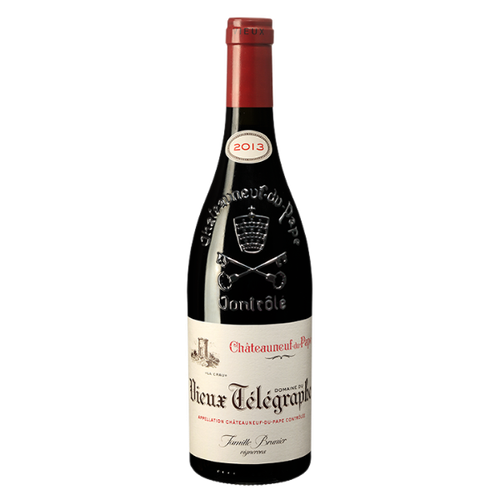
The 2017 Châteauneuf-du-Pape is another elegant, floral example from this vintage. Black raspberries, red currants, peppery garrigue, tons of minerality, and a seaweed note that I always find in this cuvée gives way to a rich, medium to full-bodied, balanced, structured wine that has everything in the right places. With good acidity, ripe, present tannin, and plenty of length, it will need 3-5 years of cellaring and keep for 15-20 years.
About Domaine du Vieux Télégraphe
It was Henri Brunier who gave birth to this beautiful family story in 1891, in the village of Bédarrides, well known today for owning the south-eastern part of the Châteauneuf-du-Pape appellation. That year, he made a donation to his son Hippolyte of plots of land located on La Crau, a place considered at that time as uncultivable, as the density of rolled pebbles made the soil ungrateful.
The latter planted his first vines on this dominant plateau, where the wine vocation dates back to the 14th century and where in 1821, Claude Chappe, inventor of the optical telegraph, installed one of his relay towers. Jules, son of Hippolyte, increased the heritage to 17 hectares and gave the fruit of his labor the well-found name of “Vieux Télégraphe”.
At the end of the Second World War, it was Henri, second of the name and fourth generation, who had the difficult task of rebuilding the heritage and watching over its destiny. Not content to increase the domain to 55 hectares in one piece, he gave this great Châteauneuf-du-Pape classic all its dimension, by creating an Vieux Télégraphe “style” and positioning it on all the most beautiful world markets.
Since the very beginning of the 1980s, his two sons, Frédéric and Daniel, have taken over the destiny of the family business in tandem. They now operate 100 hectares in the Châteauneuf-du-Pape appellation and 20 hectares in IGP Vaucluse and AOC Ventoux. To this must be added the Les Pallières estate, taken over in 1998 in partnership with their friend Kermit Lynch, which represents 135 hectares in one piece in the Gigondas appellation, 25 of which are planted with vines. 1998 was also the year of the creation of Massaya in Lebanon, in association with Sami and Ramzi Ghosn, which today represents approximately the production of 50 hectares of vines distributed mainly in the north-east of the Beqaa plain.
In 2015 and 2016, Nicolas son of Frédéric and Édouard, son of Daniel, entered the history of the Old Telegraph, by fully integrating the company into key positions.
After more than 125 years of existence, the Domaine du Vieux Télégraphe and its associated vineyards, guided by the fifth and sixth generations of winegrowers, have kept the whole of the original philosophy alive.